
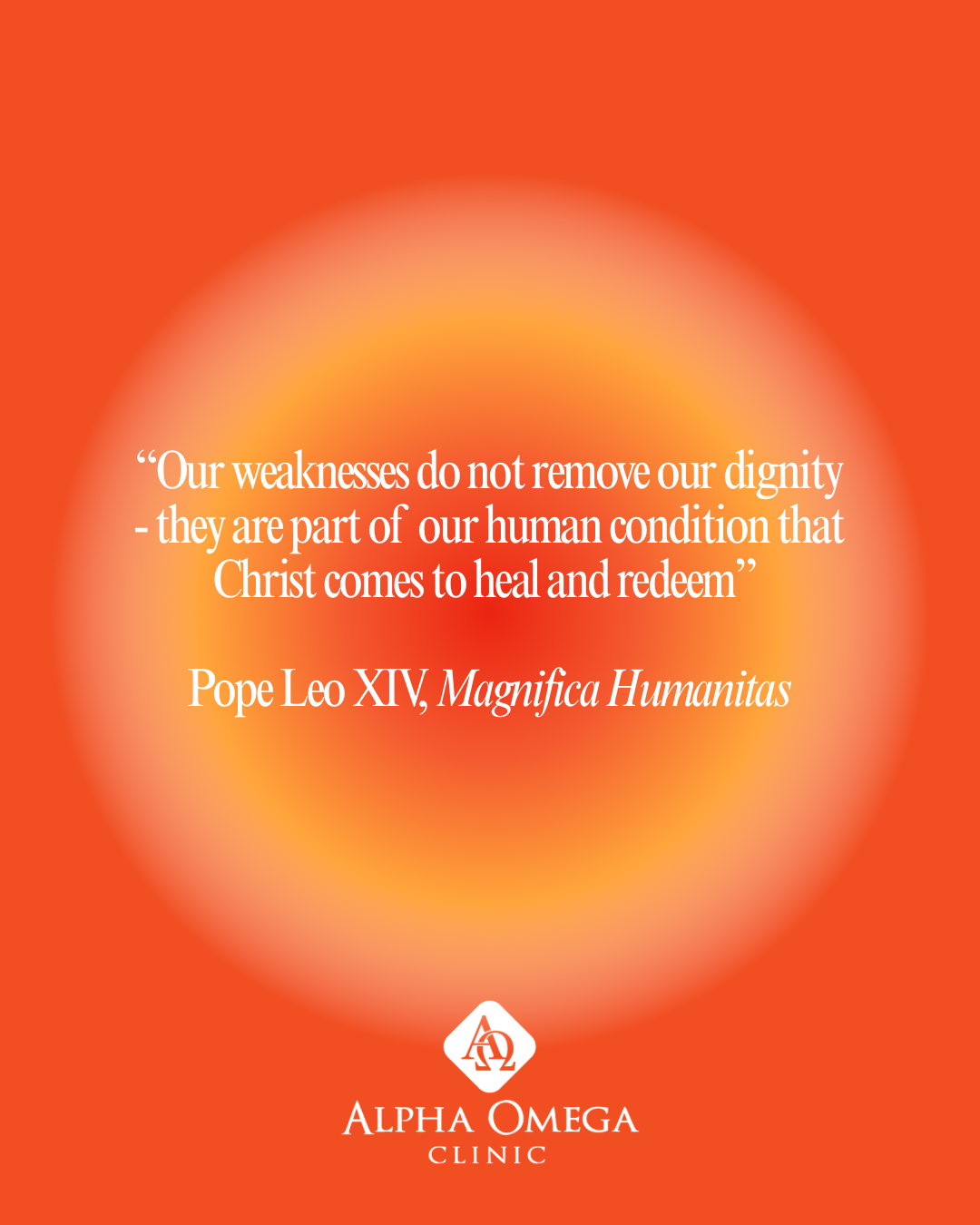
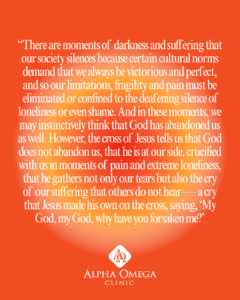
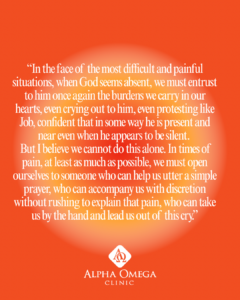

In the therapy room, we hear a version of this every week: “Maybe this happened for a reason.” “Maybe I deserved it.” “Maybe if I just understood why, it would hurt less.” “No one cares and it’ll always be this way.” So much of what brings people into therapy is shame about the very things Pope Leo names directly: the weaknesses, the wounds, the parts of us that feel unworthy of love, the suffering we are enduring. We come in believing that our struggles are evidence against our dignity; proof that we’re too much, too broken, too far gone.
Those beliefs are often the mind trying to survive what the heart hasn’t been able to hold yet.
Pope Leo names something important here: explanation is not the same as presence. A tidy theological reason for suffering can actually become a way of staying alone in it — spiritualized, but still isolated. The goal isn’t to erase the wound, it’s to bring it into relationship (with a spouse, with a therapist, with God) so it can be held rather than hidden. Healing doesn’t start with fixing yourself. It starts with being seen in the weakness and finding out you’re still loved there.
What heals isn’t the explanation; it’s not being alone in it.
Repeated exposure to love, safety, and presence, in the face of our pain, is what heals a nervous system.
Christ crucified is not a God explaining pain from a distance. He’s a God inside it.
That’s the model: Not answers, Presence.
* The information provided is for self-enrichment and not intended to replace any necessary mental health treatment.
Want to support our work? Visit aoclinic.org/donate
Want more ways to receive this content? Follow us on Instagram or Facebook or subscribe to our e-newsletter.
Warmly,
Jonathan Dixon, LMFT
Alpha Omega